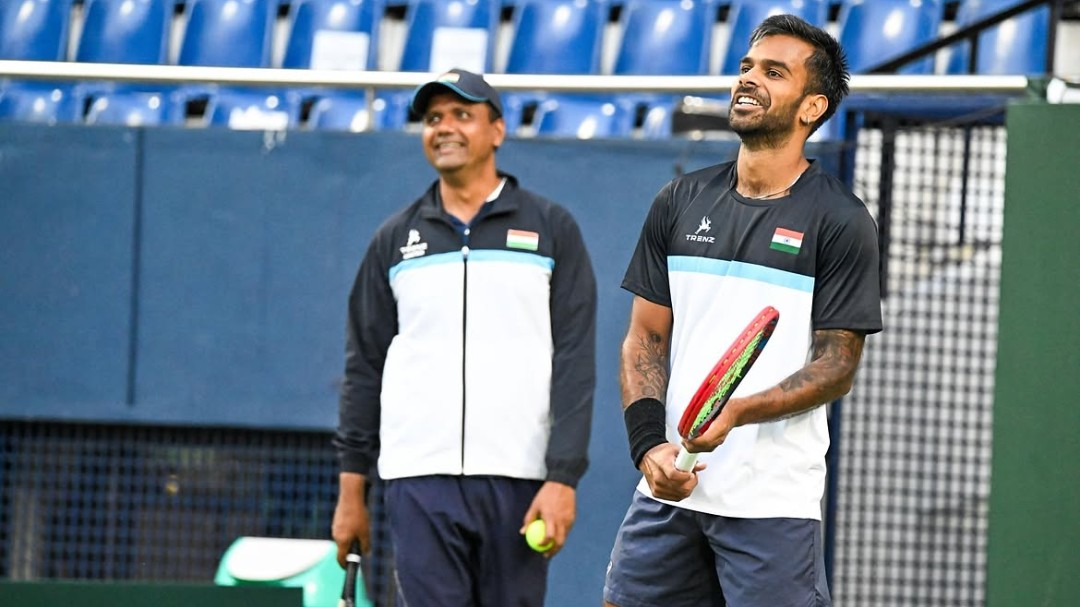
Sumit Nagal reflects on pressure, team dynamics and the importance of focusing on what India can control as they prepare to face Korea Republic in Seoul with a place in the Final 8 at stake.
With a decade of Davis Cup experience under his belt, Sumit Nagal knows the pressure that comes with representing India. As the team prepares to face Korea Republic in Seoul with a place in the Final 8 at stake, Nagal believes experience, composure and focusing on what the team can control will be key.
For Sumit Nagal, experience is not simply measured by the number of Davis Cup ties you have played. It is about understanding what comes with them.
The pressure. The atmosphere. The responsibility of representing India. And, perhaps most importantly, learning how to handle all of it.
After 10 years in the Indian Davis Cup set-up, Nagal now finds himself among the more experienced members of the group, a role he embraces as an opportunity to help the younger players coming through.
“When you have so many ties under your belt, playing for the country, seeing how things work, seeing how the team works, I guess that helps me and the team, and the newcomers. I try to share my experience as much as possible, try to help in whatever way I can. So I feel like that experience really comes into play.”
That experience will be valuable as India prepare for a different kind of challenge in Seoul.
With a place in the Davis Cup Final 8 on the line, the stakes are naturally higher. But Nagal does not believe the pressure is something unique to this particular tie.
For him, pressure is an inherent part of competitive tennis. The difference is learning how to manage it.
“There’s always pressure, right? Any match you play in tennis, there’s always pressure because you always want to win, you always want to perform.”
And that is where experience matters.
“There is pressure, but I think we’ll be okay. Just have to know how to deal with it, learn how to deal with it. And I think the more ties you play, the better you get with it.”
That ability to focus on what is within your control becomes even more important when playing away from home.
Korea Republic will have the advantage of its home crowd in Seoul, but Nagal believes India’s attention should remain firmly on its own preparation and performance.
“I think the focus will be on ourselves. How do you manage day by day? How do you manage the sets, how do you manage the points? You can’t focus on them because it is out of your control what they do, what the crowd does.”
The approach is simple: control what you can and execute at the highest possible level.
“Try to do your things at the highest level, at the best level, is what I think will be the key.”
It is a mindset shaped by years of competing at the highest level, but Nagal also recognises that Davis Cup offers something that the regular professional calendar cannot.
The team environment.
The current Indian group looks very different from the one Nagal joined when he first began representing his country. Many of the players from those early days are no longer part of the set-up, leaving Nagal with a different perspective on his role within the team.
“When I started, nobody’s part of this team anymore, except, I would say, the physio Yash. But after that, yeah, everyone’s either retired or doing their own thing.”
Yet that evolution has made the Davis Cup environment no less special for him.
If anything, it has given him a greater appreciation of it.
“Honestly, I enjoy being in this team environment. You don’t get to play Davis Cup more than two weeks a year, unless you make the Top 8. It’s a fun environment. You get to learn a lot, get to speak to the young guys.”
Nagal also sees the mix of generations in the current squad as an important part of the team's dynamic.
The experienced players understand how to navigate the pressure and demands of Davis Cup, while the younger members bring a different kind of energy and represent the future of Indian tennis.
“The older ones obviously bring experience. How to deal with things, how to deal with the matches, how to deal with the pressure. And the young ones are always an important one, because they’re the future of the country.”
For Nagal, that future is already represented within the current squad.
“Both (Manas Dhamne and Arnav Paparkar) have great potential, (they are) great kids as well. And I do believe they will work hard and they will succeed and keep the Indian flag high.”
That belief in the next generation is also closely tied to what a place in the Final 8 could mean.
For the current team, it would be a significant achievement. But Nagal believes it could also provide an important confidence boost for Indian tennis.
“It would mean a lot to the team. Also, you know, of course, it would mean a lot to the country. To enter the Top 8 in the world would really boost our confidence.”
The possibility of reaching that stage also brings back memories of India's previous Davis Cup campaign.
India's comeback against the Netherlands was one of the defining moments of the team's recent journey, with Nagal playing two matches despite making a remarkably quick return from injury.
His return was initially expected to take four to six weeks. Instead, he was back on court in just 16 days.
“For me, to play those two matches on the injury was very tough as well. It wasn’t so easy, you know. I came back in 16 days when I was supposed to be out for four to six weeks.”
He credits the team's physios for helping him make that return possible, but the bigger memory for Nagal was what the team achieved together.
“India won as a team. DK played very well, all three matches, hats off to him. It was a very proud moment for him and for the country.”
That collective spirit is something India will need again in Seoul.
The circumstances will be different. This time, Korea Republic will have the home crowd behind them. But Nagal's approach remains rooted in the same principles he has developed throughout his Davis Cup journey: embrace the pressure, focus on what can be controlled and use experience to help those around you.
For a player who has seen the Indian Davis Cup team evolve over the years, the opportunity in Seoul represents another important moment for the group.
And should India make it to the Final 8, Nagal believes the impact could extend well beyond the current generation.
For Sumit Nagal, experience is about knowing how to handle the moment. In Seoul, India will have the chance to turn that experience into another defining Davis Cup chapter.
← Back to all news